MedIntegrity WRTP-1200 Manufacturer & Supplier
WRTP-1200
Overview
Designed and manufactured by MedIntegrity LLC — the RTP integrity tester is built in our own factory, part of a 28-patent product line in pharmaceutical testing equipment.
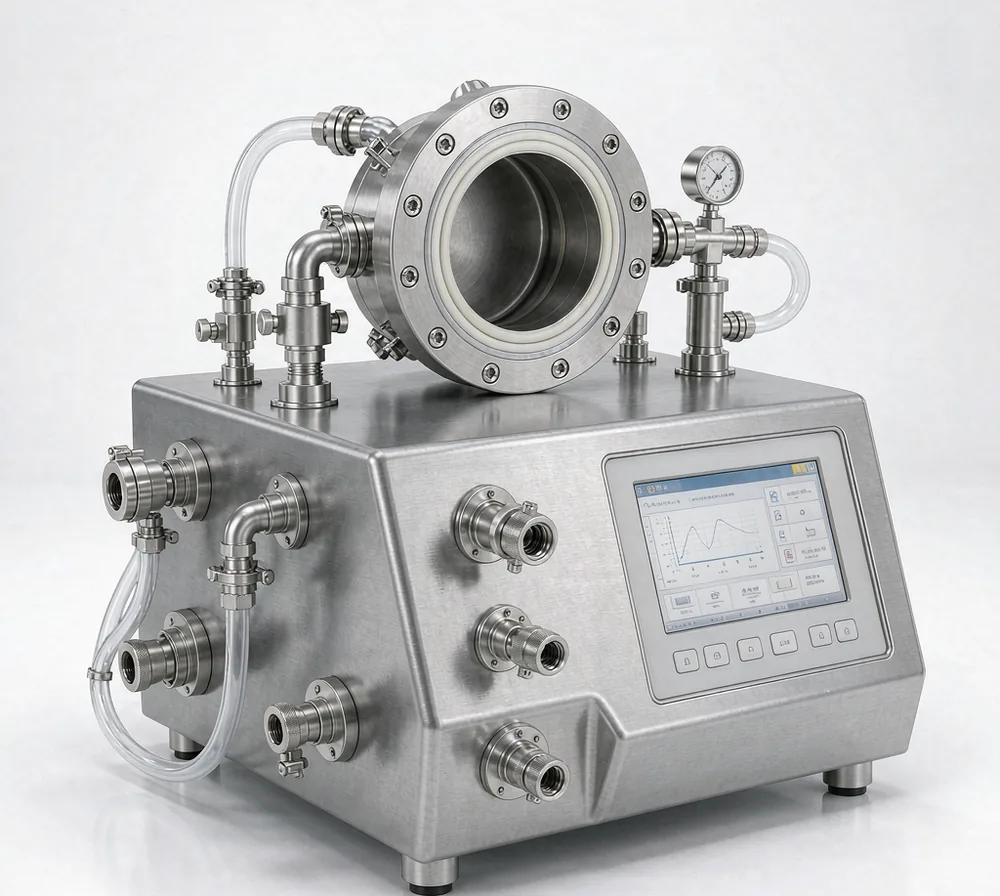
In sterile production every transfer port is a controlled opening into the process — isolators, RABS, cleanrooms. Materials move through constantly, and every one of those transfers is a place where sterility can break if the port is not doing its job. That is why the industry treats rapid transfer ports as critical components, not convenient accessories. The WRTP-1200 line exists to put a measurable check on that: integrity testing confirms the port keeps its seal during transfer, so performance and regulatory compliance are demonstrated rather than assumed. The regulatory background is in our technical notes below.
Technical Specifications
| Operating Temp Range | 5°C~30°C. |
|---|---|
| Pressure Range | Positive Pressure: 30kPa; Negative Pressure: -30kPa. |
| Materials of Construction | Stainless Steel 316L/PETP/Silicone/EPDM/PTFE. |
| Available Diameter | 190mm, 270mm, Customized. |
| Quality Standards | GMP/cGMP. |
Specifications subject to change for improvement without notice. For the latest data sheet or technical questions, contact your MedIntegrity representative.
In practice, the WRTP-1200 fits into your aseptic line for routine integrity checks, saves records for the audit trail, and ships with qualification documentation. We'll coordinate it with your IQ / OQ / PQ program.
Technical Documentation
Notes From Our Technical Documentation
The regulatory side is where this becomes less optional. 21 CFR Part 211 (cGMP) requires that sterile-line equipment — and RTPs count — be designed, installed and maintained to prevent contamination, with regular integrity testing as the evidence. FDA's Guidance for Industry on Sterile Drug Products Produced by Aseptic Processing reinforces it from the product side: the port must hold sterility during material transfer, on every transfer, not just at qualification.
In Europe, EU GMP Annex 1 requires the same integrity testing so RTPs prevent microbial contamination. The 2022 revision puts contamination control strategy at the front of the chapter, and validating your RTP systems sits squarely inside that strategy rather than in a footnote.
ISO 14644 (Cleanrooms and Associated Controlled Environments) covers the room the port sits in. In an audit the port, its electronic test records and the cleanroom get reviewed together, so all three need to stand up in the same document set.
Technical Guide
What the test verifies during a transfer
Every transfer through a rapid transfer port is a controlled opening into the process. The integrity test checks that the port performs its job: the seal stays intact, the interlocks do what they are supposed to, and the pressure relationship on both sides of the transfer holds for the duration of the cycle. The pressure range the instrument works over is +30 kPa positive and -30 kPa negative — the working envelope of the port in service, so the test covers the conditions the port actually sees.
A pass is a demonstration, not an assumption: the port held its seal through the transfer cycle, and the result is an electronic record you can point to in an audit. A fail takes the port out of service until the cause is found — which is exactly the behavior a barrier system should have.
Built with cleanroom materials
The materials of construction are 316L stainless steel, PETP, silicone, EPDM and PTFE — the standard cleanroom set, selected for cleanability, chemical resistance and long-term integrity at the transfer interface. Available diameters are 190 mm and 270 mm, with customized sizes for ports outside the standard set. Operating temperature is 5 to 30 °C, and the line qualifies to GMP / cGMP.
When a port type changes on your line — a new diameter, a new gasket material — the test program follows the port, not the other way around. The instrument is configured to the port specification, and the record carries that configuration with it.
How the data is kept
Each run carries its own header: the program name, the operator, the start and stop times, and the pass-or-fail verdict. Runs are grouped by campaign, so the history for a given port assembles itself instead of having to be gathered from log sheets kept elsewhere.
The practical effect is that the answer to an audit question is already on the instrument. Pull a campaign, a period, or a single port and the runs come back in sequence with their headers intact — no separate binder to maintain, no memory of which result landed in which folder.
Why the measurement side is wireless
The WRTP-1200 reads the port without a cable running through the isolator or RABS wall. That matters because a cable is itself a penetration: every hole in a containment barrier has to be rated, sealed, cleaned and re-checked, and each one is a place the barrier can be compromised. Keeping the sensing side off the barrier removes that path, and it lets the instrument sit outside the classified zone, where it is easier to service and to keep qualified.
The wireless link is also what makes a port test work the way it needs to. A wired setup would route a line through the barrier at exactly the point you are trying to prove is intact, which quietly undermines the test. The wireless arrangement lets the port be checked in its installed state, under its real service conditions, without opening a temporary hole in the wall to do it.
Fitting the test to the isolation strategy
On an isolator line the transfer ports are the points where the containment chain is deliberately interrupted, and each one is a place the contamination control strategy has to account for. The port's integrity test therefore sits alongside the isolator's own qualification and routine leak checks, so the barrier, the port and the room are described by one consistent set of records rather than three separate ones.
Because the instrument reads the port in place, the result reflects how the port is actually fitted — the flange, the gasket seating, the way the interlocks engage during a real transfer. A bench test of the port by itself would miss that, and the in-place check is what keeps the result about the installed barrier, not a component sitting in isolation on a table.
What the routine actually costs
A transfer-port test takes minutes, and nothing on the line stops for it: the port is tested in place, the cycle runs to completion, and the operator is free to keep working while the instrument logs the result. On a line that makes many transfers a day, that is the difference between a routine that holds and one that slips past the next busy campaign.
A year of such checks builds up into a history you can read against the commissioning baseline — the same instrument, the same program, the same kind of number every time, which is what makes the trend visible when a port starts to drift.
Planning the test schedule around the line
The test schedule is where the requirement becomes practice. At commissioning, before the port is relied on, the baseline is set and recorded. After any repair or replacement of the port or its gasket, the test runs again to confirm the change did not move the result. And on the periodic interval your SOP defines, the test repeats, so the record shows the port held its integrity over time rather than only at one point.
When the line itself changes — a new diameter, a replaced seal — the instrument gets reconfigured to the port's new specification, and the re-test confirms the result did not move. That is the sequence your IQ/OQ/PQ documentation is built around, and it is the same sequence every time, which is what keeps the schedule maintainable across a long campaign.
Frequently Asked Questions
Which port diameters does it cover?
190 mm and 270 mm as standard, with customized diameters available for ports outside the standard set.
What is the pressure range?
+30 kPa positive and -30 kPa negative — the working envelope of the rapid transfer port in service.
What are the materials of construction?
316L stainless steel, PETP, silicone, EPDM and PTFE — the standard cleanroom material set for the transfer interface.
What is the operating temperature range?
5 to 30 °C per the specification, with GMP / cGMP qualification.
How does it fit a maintenance program?
At commissioning, after any repair or replacement of the port, and on the periodic interval your SOP defines — with the electronic record as the evidence for each.
What does RTP integrity testing cover on our instruments?
Integrity testing for aseptic pharma production lines, with results saved as electronic records.
Is qualification documentation included?
Yes — IQ / OQ / PQ documentation is part of the delivery, aligned with GMP validation practice.
Can it fit into an existing qualification program?
Yes. The instrument and its documentation are built to slot into an existing IQ / OQ / PQ program; we'll coordinate the details with your team.
Need a quote or technical advice?
Tell us your application — our U.S. team responds with product selection, documentation and pricing.
Request a Quote